We put the dead internet theory to the test on ten platforms. It is only dying where nobody talks back.
Measured against each platform's own pre-LLM baseline, AI-flagged text roughly doubled on blogs and dev.to since 2020, stayed flat on Reddit, Hacker News, Mastodon, GitHub and Stack Overflow, and the conversational web still reads mostly human.
The dead internet theory says the internet you are reading is mostly fake: bot-written posts, machine-generated articles, automated engagement, with real people reduced to a minority audience wandering through it. It grew out of imageboard threads and was crystallized in 2021 by a forum post titled "Dead Internet Theory: Most of the Internet is Fake", then carried into the mainstream by an Atlantic piece the same year. The full theory bundles claims nobody can measure, including intent and coordination. But its core empirical claim, that machine text has displaced human text across the public web, is exactly the kind of thing a calibrated detector can check.
So we checked. Ten platforms, one fixed detector threshold, and a control that most "how much of the internet is AI" charts skip: every platform is compared against its own posts from before LLMs existed.
The measurement
The unit is a public English post of 40 to 150 words. We drew uniform random samples from each platform's 2025 to mid-2026 posts, and, wherever the platform is old enough, an equivalent sample of its 2016 to 2019 posts: Hacker News through its public API (random item IDs, every year back to 2016), Reddit through the Arctic Shift archive (random timestamps across all subreddits), Medium, Blogspot, Substack, Mastodon, dev.to and unrolled X threads through Common Crawl with per-post publish dates, and Stack Overflow and GitHub issues through their official APIs. Roughly 18,000 sampled posts were scored by our calibrated AI-text detector (Unslop-MoE-v7) at its strict operating point, the same fixed threshold for every document. Confidence intervals are bootstrapped and clustered by author or thread, because posts from one author are not independent evidence.
The pre-2020 samples are the trick. No LLMs existed, so every flag on those posts is a false positive, and the flagged share is the detector's error rate for that platform's style of writing. Casual comment prose trips an AI detector far more often than lab benchmarks suggest: our pre-LLM false-alarm floors run from about 5% on Hacker News to about 14% on 2018-era X threads. Any chart that ranks platforms by raw "percent AI" without that per-register floor is mostly ranking detector error. The honest question is not "which platform scores highest" but "who rose above their own floor."
Who rose above their own floor
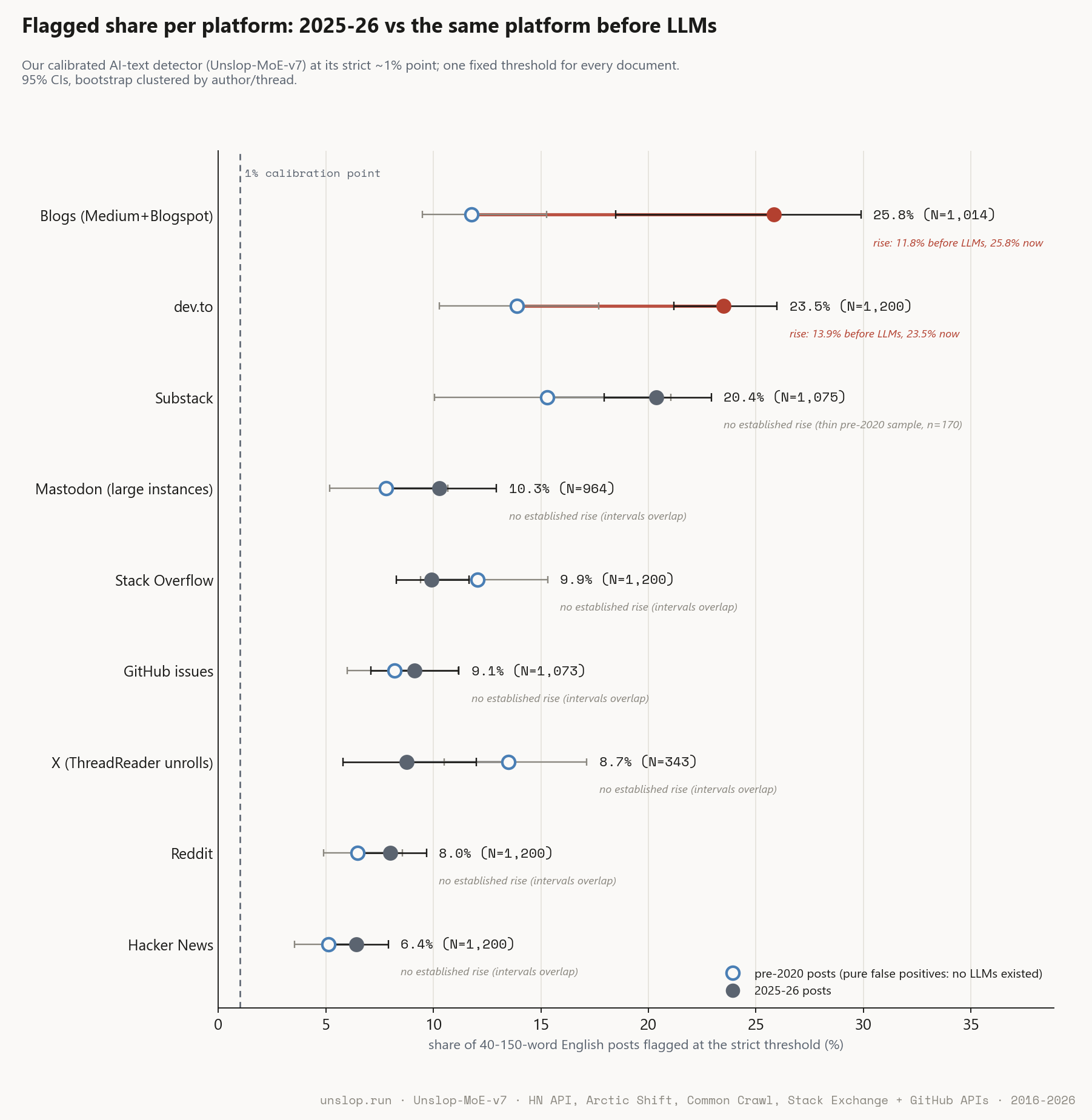
Two platforms clear their pre-LLM baseline with room to spare, and both are places where text is published one way, at article length:
- Blogs (Medium and Blogspot ledes): 11.8% flagged before LLMs, 25.8% now (N=1,014,
interval [18.5, 29.9] against a baseline interval of [9.5, 15.3]). The rise holds inside Medium and inside Blogspot separately, so it is not an artifact of pooling.
- dev.to article openings: 13.9% before, 23.5% now (N=1,200, [21.2, 26.0]).
Substack sits high at 20.4% but its pre-2020 sample is thin (the platform was tiny then, n=170 at 15.3%), so we do not claim a rise. And then there is everyone else:
- Reddit: 6.5% then, 8.0% now. Intervals overlap.
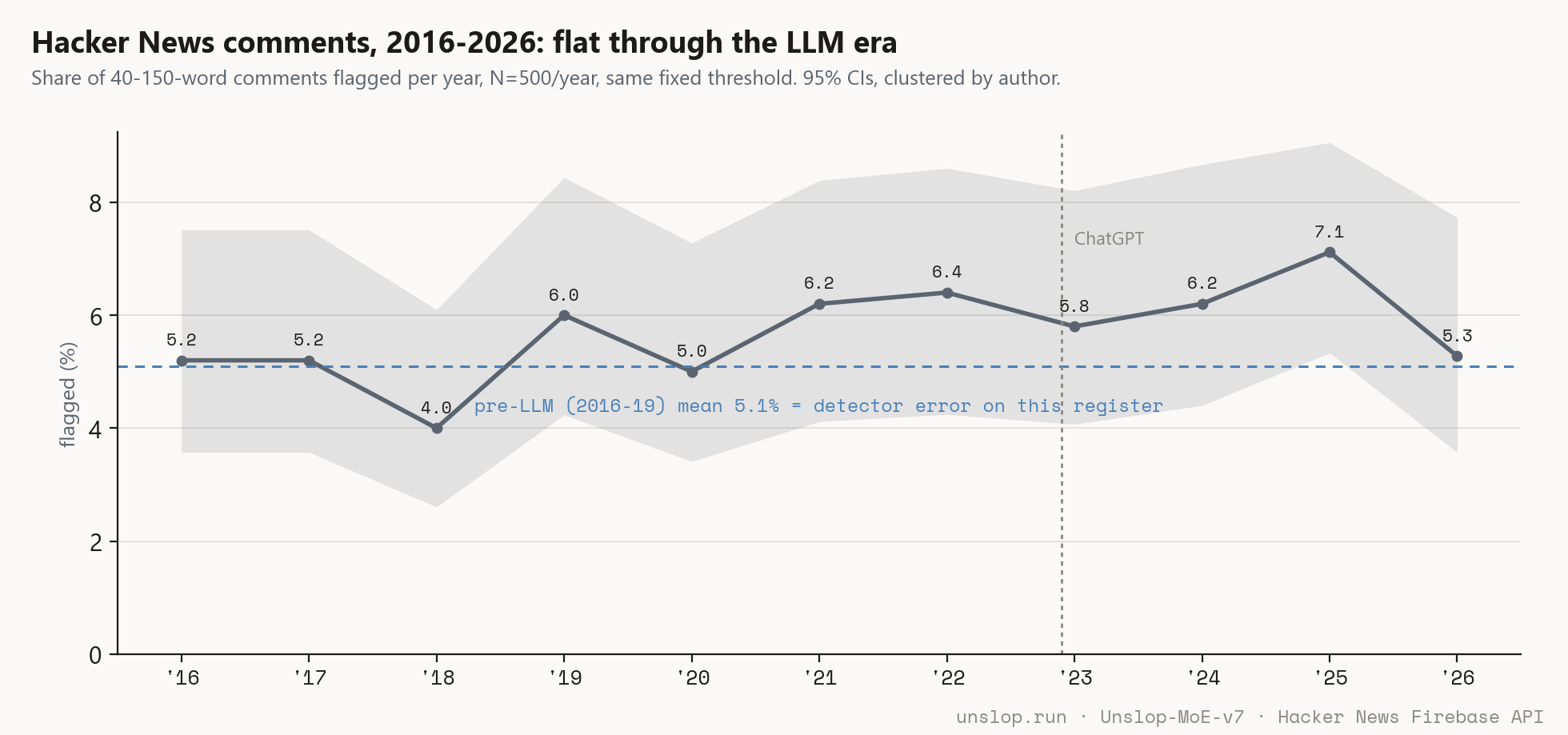
- Hacker News: 5.1% then, 6.4% now. Intervals overlap. Year by year, HN is
remarkably flat: 2016 to 2019 average 5.1%, and no year since ChatGPT has broken 7.2%.
- Mastodon: 7.8% then, 10.3% now. Overlapping.
- GitHub issues: 8.2% then, 9.1% now. Overlapping.
- Stack Overflow: 12.0% then, 9.9% now. Below its pre-LLM baseline.
- X threads (via ThreadReader unrolls): 13.5% then, 8.7% now. Also below baseline.
The two below-baseline results deserve a plain reading. Stack Overflow's 2018 question prose, often written by non-native speakers under heavy formatting conventions, reads as more formulaic to a detector than its 2025 survivors, whose volume collapsed and whose authors now skew toward people who chose not to just ask a chatbot. The unrolled X threads of 2018 and 2019 were saturated with crypto and growth-hacking formula. A detector's false alarms have history too.
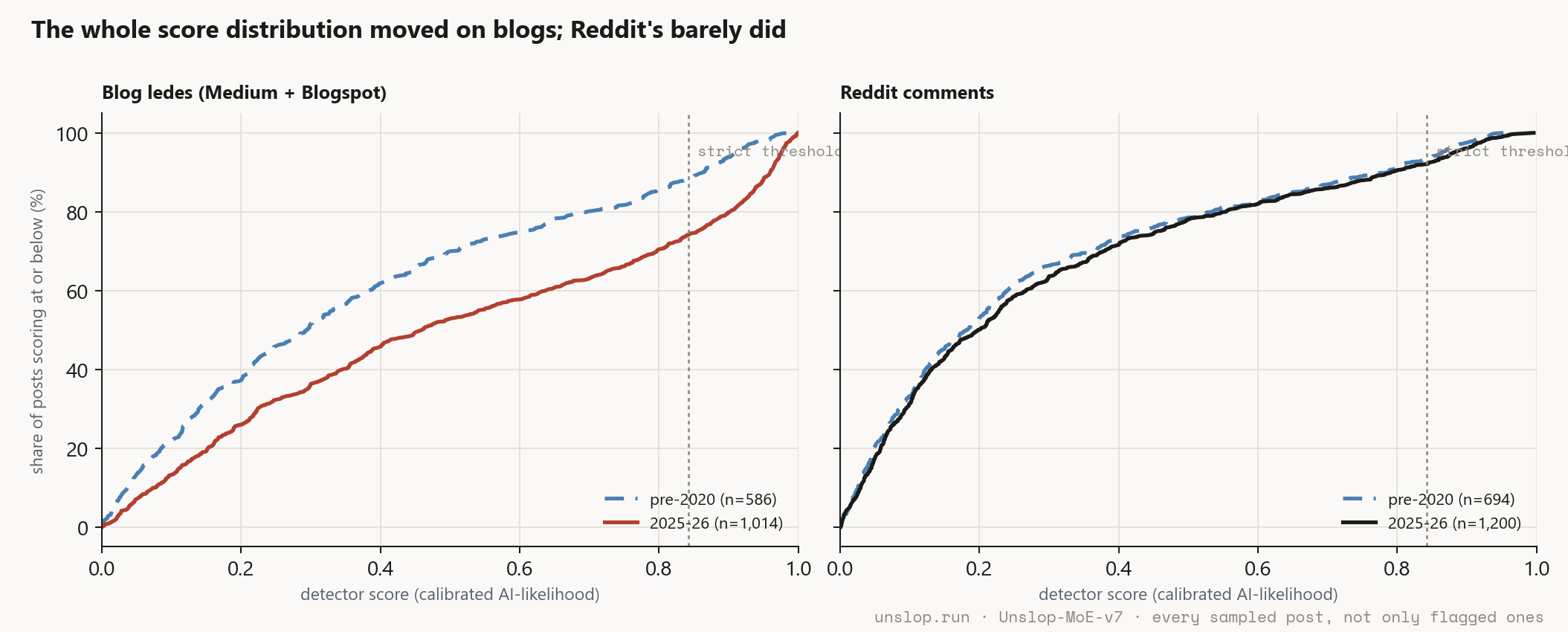
The flag rate compresses everything into one number, so here is the same contrast without a threshold: the full score distribution of every sampled post. On blogs, the whole curve slid toward the machine end between the two eras. On Reddit, the two curves lie almost on top of each other.
The short-message caveat
There is one honest wrinkle to put next to the conversational result: most comments are short, and short text is where any detector has the least to work with. Split the same posts by length and you can watch the instrument sharpen. In the 40-70 word band the pre-LLM false-alarm floor sits near 10% and the then-versus-now dots land on top of each other: at that length, genuinely inconclusive. In the 110-150 word band the floor drops to about 3%, and there a small conversational uptick does become visible, 2.8% before LLMs to 5.5% now, though the intervals still touch. The one-way platforms separate cleanly in every band with enough data.
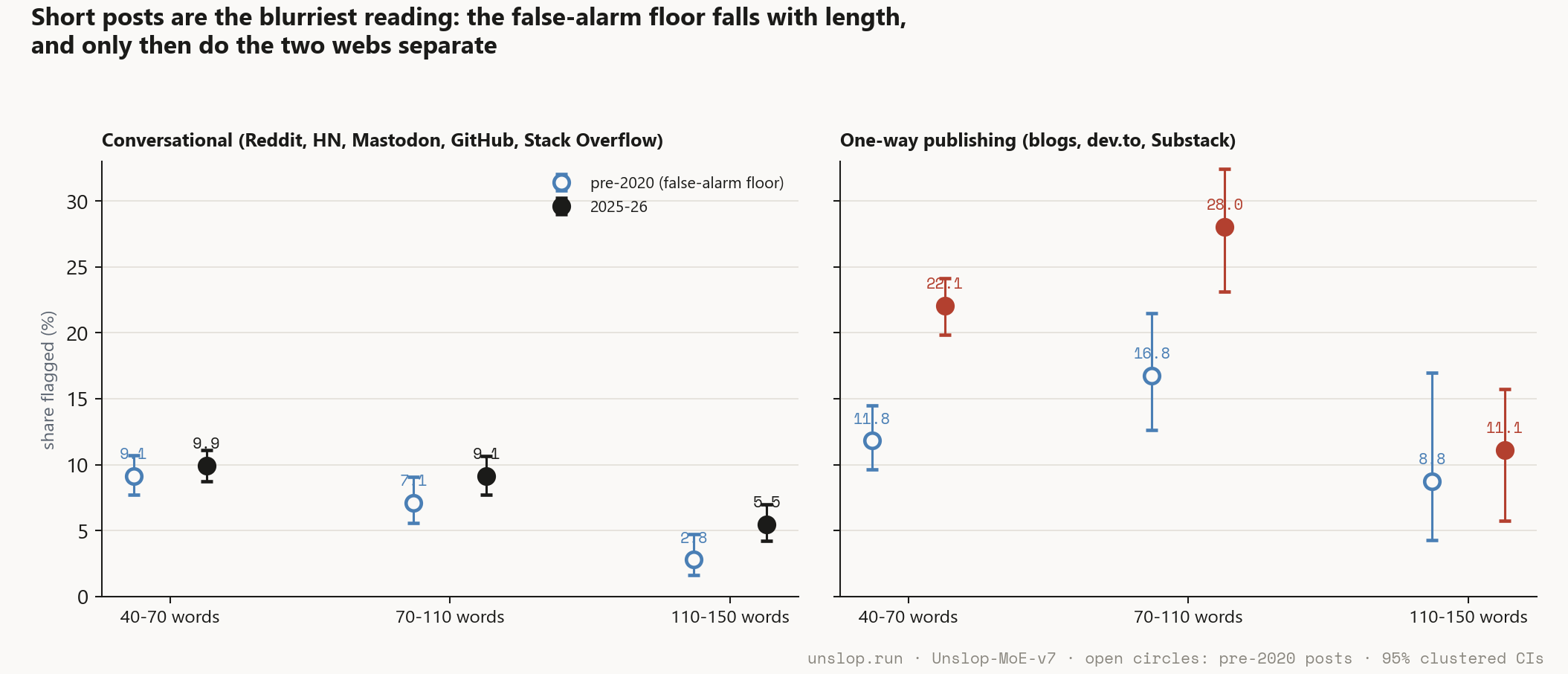
So the fair summary of the conversational web is not "definitely human." It is: at short lengths the question is close to unanswerable per post, and at the lengths where the detector is most reliable, the rise that appears is real but modest, nothing like the doubling on the broadcast side. Long-form text is where this instrument stands on firm ground, and long-form text is exactly where the machines have moved in.
What this says about the theory
The dead internet theory, read as "machine text has displaced human text everywhere," does not survive contact with the conversational web, with the caveat above attached. Reddit comments, Hacker News threads, Mastodon posts and GitHub issues in 2025-26 are statistically indistinguishable from their pre-LLM selves at the lengths where our instrument is sharpest, and unreadable rather than machine-like at the lengths where it is not. If the replies around you feel alive, the honest version is: at the resolution of this instrument, mostly they are, and where the instrument blurs, we say "blurry" rather than "bot."
Read as "the broadcast web is filling with machine-written articles," the theory is in much better shape. One in four blog ledes now trips a detector calibrated to flag about one in a hundred of the same platform's pre-LLM posts. That is a doubling in five years, it is visible on every one-way publishing surface we could measure, and nothing in our data says it has peaked.
Two honest gaps. First, the walled platforms: LinkedIn, Facebook, Bluesky, Tumblr and YouTube comments cannot be sampled from permitted public sources in 2026 (login walls and crawler blocks; we probed each), so the theory remains untested exactly where engagement farming is most often alleged. Second, detectors flag detector-visible text: a heavily edited AI draft or a lightly AI-polished human draft sit in a gray zone no instrument cleanly splits. These numbers are prevalence estimates of machine-typical writing with stated error floors, never verdicts on any individual post or author.
Method notes
Sampling seed 20260716 everywhere; English only (langdetect at 0.90 or above); markup, quotes and URLs stripped before the word-count band; declared bots and moderators dropped; exact and near-duplicate posts removed before sampling; N per platform is 1,000 to 1,200 in the current window except X threads (N=343, the full in-window public pool, marked as such). The length-band figure splits the same posts at 70 and 110 words with the same clustered intervals; nothing else changes between bands. Telegram was sampled but its crawl-visible channels are about 96% non-English, leaving too little for a claim. Ranking order is unchanged at looser and stricter thresholds. All flagged shares are shares of the strict-threshold flag, reported with 95% clustered bootstrap intervals against each platform's own pre-2020 baseline where one exists.
The dead internet theory imagined the whole internet dying at once. What we measure looks more specific: the parts of the web that talk back are alive and unremarkable, and the parts that publish at you are quietly filling with text that reads like a machine wrote it. If you want to know which kind you are reading, that is what we built the detector for.